
Nonfiction
The Authoritarian Voter
Forthcoming
What if the most persistent threat to American democracy is not a single leader, but a recurring pattern of voters responding to fear, uncertainty, and social change?
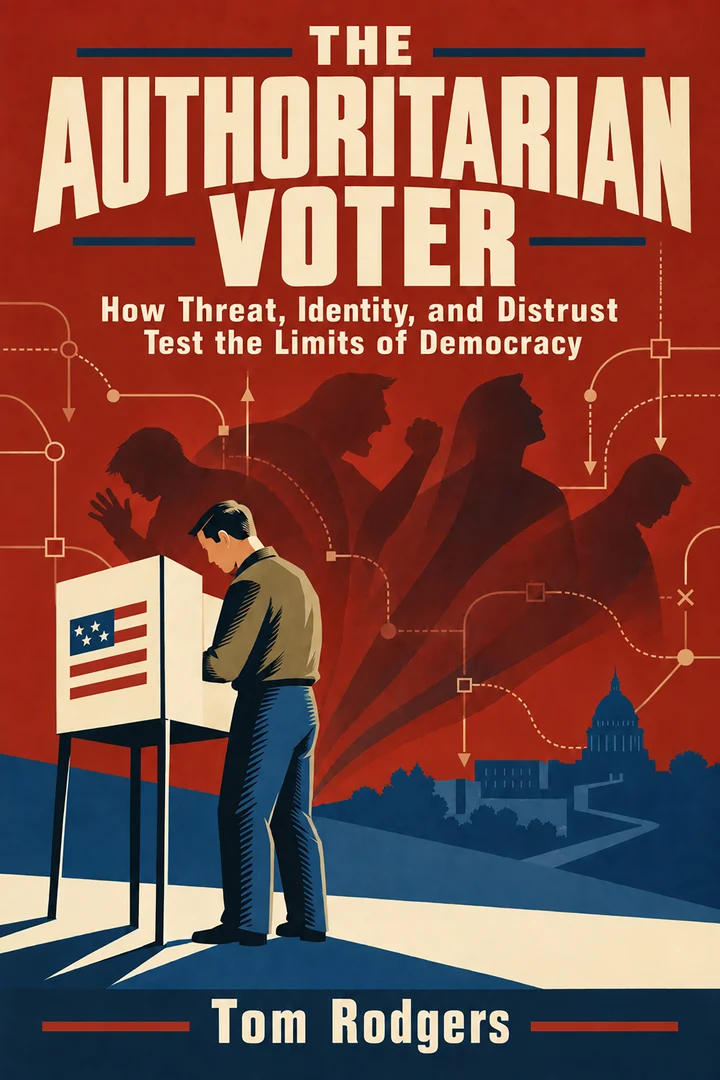
The Authoritarian Voter investigates why a persistent portion of the American electorate supports leaders and policies that concentrate power, restrict civil liberties, or elevate order over pluralism.
Drawing on polling data, historical evidence, political psychology, and more than 275 documented sources, Tom Rodgers traces recurring patterns across modern American political life. The focus is on the conditions under which voters choose to give leaders greater power—and the democratic safeguards placed under strain by those choices.
The question behind the book
Political discussion often centers on authoritarian leaders, their personalities, and individual elections. This book turns the question toward citizens: why do voters repeatedly become willing to surrender democratic safeguards, tolerate restrictions on others, or put perceived security and order ahead of pluralistic institutions?
An analytical framework
A recurring system
Five interacting mechanisms form a feedback system. Under conditions of crisis, disruption, threat, political shocks, or information shocks, they can reinforce one another.
Threat sensitivity
Out-group hostility
Punitive politics
Epistemic control
Strong-leader preference
Interacting mechanisms · Reinforcing feedback
Corrective democratic safeguards
- Institutions
- Information
- Norms
- Trust
Across American history
The book follows recurring mechanisms across different historical circumstances. These periods are not identical; each provides a different setting in which to examine the relationship between voters, power, and democratic safeguards.
- McCarthyism
- Civil-rights backlash
- War on Drugs
- Post-9/11 security state
- Twenty-first-century politics
An incident-analysis approach
Tom Rodgers brings a professional background in information technology, disaster recovery, and major-incident management to the analysis. In that work, understanding a failure means reconstructing the sequence, identifying contributing factors, locating feedback loops and safeguards that failed, and asking why similar failures recur. The Authoritarian Voter applies that systems-oriented lens to political history.
Research foundation
More than 275 documented sources underpin the book's analysis, bringing together polling, historical evidence, and research in political psychology.
Publication
The Authoritarian Voter
Forthcoming